Homeowners spend a lot of time choosing shingle colors and very little on the layer underneath. That layer is the roof's backup: when wind lifts a shingle or water backs up at the eaves, it's what keeps the deck dry.
Synthetic underlayment is a woven polymer sheet that is lighter, stronger and more tear-resistant than traditional asphalt felt, and it tolerates more exposure before the shingles go on. Felt costs less but tears and wrinkles more easily. Most new roofs now use synthetic.
Underlayment is only part of the picture, though. Ice and water shield does a different job, and a good roof uses both in the right places. Neither shows once the shingles are on, which is exactly why it pays to know what your quote includes.
What is felt underlayment?
Felt underlayment, often called tar paper, is a paper or fiberglass mat soaked in asphalt, sold mainly in #15 and #30 weights. It was the standard for decades and still meets code, but it absorbs some moisture, tears under foot traffic and can wrinkle under shingles.
Wrinkled felt can telegraph through the shingles as ripples. Felt also has a short window before it needs to be covered, which matters if weather interrupts a job.
Why do most roofers use synthetic now?
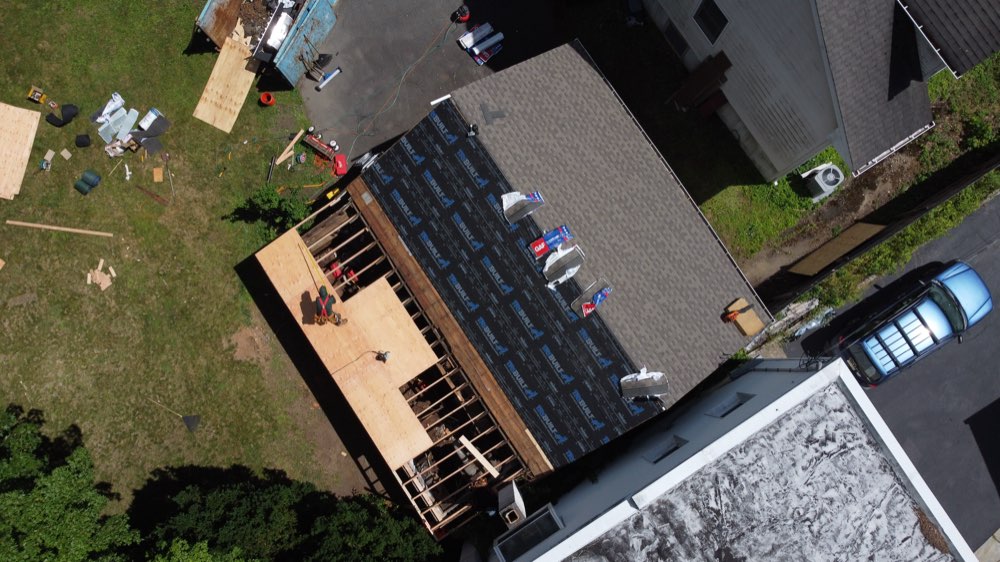
Most roofers now use synthetic underlayment because it resists tearing in wind and under foot, lies flat, sheds water if rain hits mid-job, and comes in longer rolls that leave fewer seams. Its higher material cost is a small share of a full roof.
It's also safer to walk on, since many products have a textured surface. The exact exposure limit and fastening pattern vary by brand, so it should be installed to the maker's instructions.
Where does ice and water shield go?
Ice and water shield goes along the eaves, through every valley and around chimneys, skylights and walls. In areas where ice dams are common, the residential code calls for an ice barrier from the eave to at least 24 inches inside the exterior wall.
Unlike regular underlayment, ice and water shield is a self-adhering rubberized membrane that seals around nails. That's what stops meltwater backed up behind an ice dam from reaching the deck. On low-slope sections, such as long ranch roofs or porch roofs, it can make sense to cover more area.
Does underlayment affect the shingle warranty?
Underlayment can affect the shingle warranty, because manufacturers set requirements for what goes under their shingles, and enhanced system warranties usually require their own brand of underlayment and accessories. Using the wrong product can limit coverage.
The standard shingle warranty is usually satisfied by any underlayment that meets code, but it's still worth asking which product will be used and keeping a record of it. If a quote offers an extended manufacturer warranty, confirm that the underlayment, starter strips and ridge caps listed are the ones that warranty requires.
What should your quote say about underlayment?
A roofing quote should name the underlayment type and say exactly where ice and water shield will go, in feet from the eaves and in which valleys. "Underlayment included" on its own doesn't tell you what you're getting.
Ask for synthetic over the full deck and ice and water shield at the eaves, valleys and every roof penetration. It's a small part of the price and a big part of how the roof handles its first nor'easter. See how it all fits in our guide to comparing roofing quotes, or get a free quote.
Need help with this in Livingston?
We'll take a look and give you a free written quote. Learn more about roof replacement in Livingston.